Does a breakup really hurt less as we get older? Direct evidence
Research does not show that breakups necessarily affect us less as we get older. In a study that followed 1,530 people after a breakup, feelings of loneliness and depressive symptoms increased on average, while life satisfaction decreased. Age did not have a significant effect, as younger and middle-aged adults experienced the breakup in similar ways.
In practical terms, the study did not show that a 45-year-old would necessarily be less affected by a comparable breakup than a 25-year-old. Interestingly, however, middle-aged adults were less satisfied with being single after a breakup and were more likely than younger adults to want a new partner.[1]
Research on emotional aging does suggest that, as people get older, many develop better skills for regulating emotions and choosing less conflictual situations.
However, this is not a simple progression in which everyone automatically becomes “stronger” or less affected with age. Researchers also point out that the evidence does not support the claim that older adults are better at regulating their emotions in every situation.[2]
Later in life, a relationship often involves much more than simply being in love: a shared home, family, friends, routines, a sense of security, and plans for the future.
This is why a breakup can be just as painful, or even more difficult, even if we may appear to handle it more calmly on the outside. [3]
Short answer: A breakup at 25 is not the same as a breakup at 45, and every person experiences it differently. However, science does not support the simple rule: “The older I am, the less it will hurt.” The intensity of our response depends more on the significance of the relationship, attachment, the circumstances of the breakup, the sense of loss, and the support we have.
What happens in the body and brain when we fall in love and when a relationship ends?
Falling in love is not just an emotion. At the beginning of a relationship, we may experience more energy, butterflies in the stomach, a faster heartbeat, poorer sleep, and thoughts that keep returning to the other person.
Behind these experiences are brain systems involved in reward, motivation, and emotions, as well as various neurotransmitters and hormones, including dopamine and oxytocin. [4] Love is an interplay of bodily responses, past experiences, our thoughts and behavior, and the relationship we build with another person.
Over time, the initial feeling of being in love also develops into attachment. A partner can become the person we turn to for closeness, security, and support, and with whom we share a large part of our everyday life. This is precisely why a breakup does not simply end a relationship – we also suddenly lose the person to whom we were emotionally attached and with whom our life had become intertwined. Our established sense of whom we turn to in times of distress and with whom we share our daily life also changes.
After a breakup, we may experience tightness in the chest, restlessness, sleep problems, loss of appetite, fatigue, irritability, or the feeling that our thoughts are going around in circles. Such a response is not a sign of weakness, nor does it mean that we should “just pull ourselves together.”
An important attachment has been disrupted, and the body and mind are trying to understand the change and adapt to it.
In a small fMRI study of people who had recently been rejected by their partner but were still in love, researchers observed activation in brain regions associated with reward, craving, gains and losses, and emotion regulation.
This helps us understand why someone can know that a relationship was not good for them and still miss their partner deeply. Rational understanding and emotional attachment do not necessarily change at the same pace.[5]
However, it is important to be precise: brain studies do not tell us that a breakup is literally the same as a physical injury, nor can they predict how long the pain will last for an individual. What they do show is that romantic rejection is associated with measurable processes in systems that are important for motivation, attention, and emotional responses.
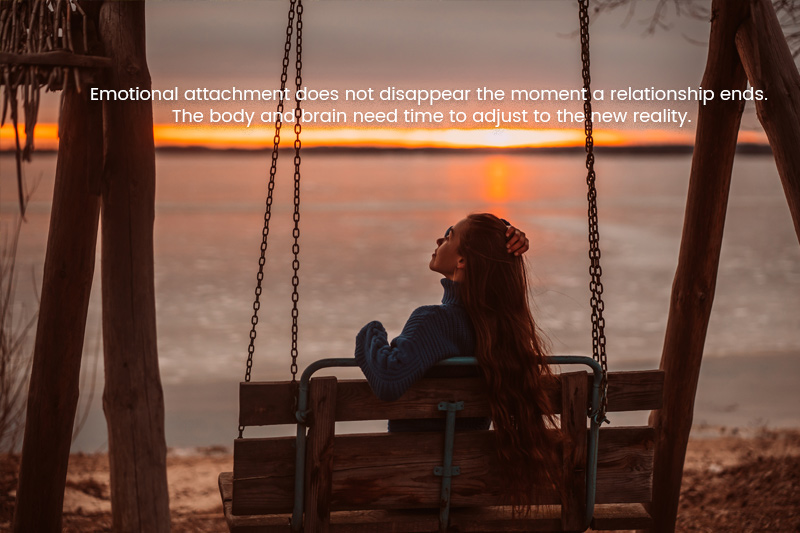
What has the greatest impact on the pain after a breakup?
What matters most is the story of the relationship, not your date of birth. A breakup that has been expected for a long time and is understood by both partners can feel very different from a sudden betrayal or an ending without explanation. Research among young adults also links greater distress to attachment insecurity and coping strategies such as self-blame and repetitive rumination, while more adaptive strategies, such as acceptance and redirecting attention, have been associated with fewer symptoms of anxiety and depression. [6]
| Factor |
Why it can make recovery more difficult or easier |
| Unexpected breakup or betrayal |
It can undermine a sense of security and often leave many questions without clear answers. |
| Who initiated the breakup |
The person who was left may experience a greater sense of helplessness; however, the person who ends the relationship may also feel sadness, guilt, or loneliness. |
| Length and interconnectedness of the relationship |
More shared routines, people, and plans mean more aspects of life that need to be reorganized. |
| Attachment style |
Fear of abandonment or a tendency to suppress emotions can complicate recovery in different ways. [6] |
| Clarity and understanding |
Understanding why the relationship ended was associated in one study with less emotional distress and better functioning in later romantic relationships. [7] |
Can we control our response after a breakup?
We cannot control whether we feel sadness, anger, relief, or longing. Trying to override emotions with logic often only prolongs the inner struggle. However, we can influence the conditions for recovery: how much space we give ourselves to grieve, how we limit additional triggers, whom we turn to for support, and how we talk to ourselves about the story of the relationship.
To begin, we can ask ourselves a few gentle but clear questions:
What do I really miss – the person, the routine, the sense of belonging, or the future I had imagined? What do I know about the reasons why the relationship ended, and what will I never be able to find out? Where in my thinking am I taking responsibility for things that were not mine alone? These questions are not a quick solution, but they can help clear the fog in which self-blame and the endless search for explanations tend to arise.
Practical tips to help yourself
| It is not about forcing yourself to “get over it” |
It is about supporting yourself so that your nervous system and daily life can gradually settle down |
| I will stop feeling anything. |
I name what I am feeling and allow the emotion to come and pass. |
| I have to check what they are doing every day. |
I set boundaries around contact and checking their social media when it is not necessary. |
| It was all my fault. |
I distinguish between my share of responsibility, my partner’s responsibility, and the things that were beyond my control. |
| I have to get through this on my own. |
I choose one or two people I trust and can talk to without shame or pressure to find a quick solution. |
| I need a new relationship immediately. |
First, I reconnect with my own rhythm, my body, my friends, and my values. |
At the same time, do not forget basic self-care. Regular sleep, nourishing meals, some physical activity, a daily routine, and staying connected with other people are not insignificant details when we are emotionally overwhelmed.
They provide a framework in which the body can more easily recognize that, despite the loss, we are still safe. If the distress significantly interferes with your sleep, work, caring for your children, or everyday functioning for an extended period, or if you experience feelings of hopelessness, talking to a psychologist, psychotherapist, or doctor is a reasonable form of support and not a sign that you have failed to cope on your own.
Conclusion: Experience does not erase our need for connection
As we get older, we can learn to choose healthier relationships, recognize warning signs earlier, and set clearer boundaries. That is valuable.
However, experience does not erase our human need for closeness, security, and belonging. That is why a breakup later in life does not necessarily hurt less; sometimes, it simply hurts differently.
Perhaps it feels less chaotic because we know ourselves better. Perhaps it hurts more quietly because we have more shared history and more aspects of our lives to rearrange. In either case, recovery is possible. Not because love should become less important, but because after a loss, we can gradually learn to reconnect with ourselves, the people in our lives, and a future that is still ours.
Frequently Asked Questions About Breakups
Do we recover from a breakup faster as we get older?There is not enough evidence to give a general answer of “yes.” A direct comparison of younger and middle-aged adults after a breakup did not find that age predicted a smaller decline in life satisfaction, fewer depressive symptoms, or less loneliness. Some people may find it easier to cope with their emotions because of greater life experience, clearer boundaries, and a broader support network, but age alone does not determine the speed of recovery. More important factors include the quality and significance of the relationship, the circumstances of the breakup, attachment, mental well-being, and the support available in one’s environment.[8]
How long is it normal to feel pain after a breakup?There is no single timeframe that applies to everyone. Research averages should not be used as a measure of your worth or as a deadline for recovery. It is more helpful to notice whether, with time and support, moments of relief begin to appear and whether the distress still allows you to manage basic everyday activities. If it does not, seeking professional support can be helpful. [8]