The Brain Looks for Danger Even When We Feel Safe
Our brains constantly assess what is happening around us and look for potential threats. When we find ourselves in an uncertain situation, our minds may start asking: “What could go wrong?” This can be useful because it allows us to prepare for potential difficulties.
The problem arises when one possible explanation turns into an almost certain prediction, even though we don't have enough evidence to support it. Several areas of the brain are involved in detecting and regulating responses to threats, including the amygdala and the prefrontal cortex, which play a role in processing emotional information, judgment, and regulating responses. [1]
When we are stressed or sleep-deprived, uncertainty can feel more difficult to manage. We may become quicker to notice potential threats and find it harder to consider alternative explanations. [2]
Sometimes, what troubles us is not just the possibility that something might go wrong, but the fact that we don't have an answer yet. In psychology, this is known as
intolerance of uncertainty, which means experiencing uncertain situations as particularly uncomfortable or difficult to accept.
Research has linked it to excessive worry and anxiety. [3] Creating negative scenarios can be an attempt to regain a sense of control. We may find ourselves thinking: “If I anticipate every possibility, nothing will catch me off guard.” But there is an important difference between preparing for a problem and constantly dwelling on it. The first can help us find a solution, while the second often keeps us trapped in a cycle of worry. [4]
The message “Can we talk tomorrow?” is simply information. The thought “It must be bad news” is just one possible interpretation, not a fact.
Why Do Negative Scenarios Escalate So Quickly?
When we anticipate danger in our minds, our body may react as well. Our heart starts beating faster, our muscles tense up, and our breathing becomes shallower. These sensations are real, but they don't necessarily tell us whether the scenario playing out in our minds will actually happen.
This can create a vicious cycle:
An unpleasant thought triggers tension, and that tension makes us even more convinced that something must be wrong. To calm ourselves down, we go over every possibility again and again. We may seek reassurance from others or start avoiding situations that make us feel uncertain.
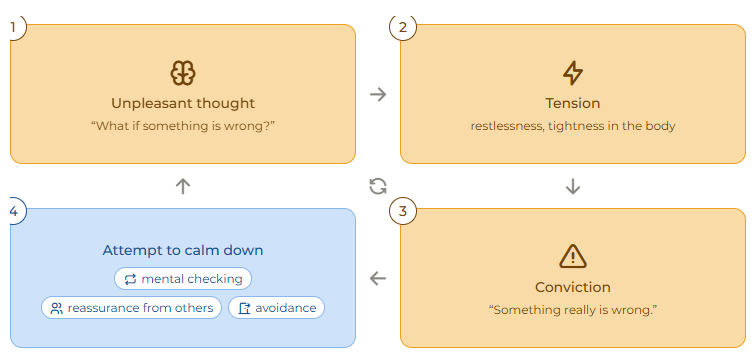
Imagine repeatedly asking someone after sending a message: “Are we really okay?” Their answer may reassure you for a short while. But if you repeat the same behaviour every time uncertainty arises, you may develop a habit of needing further reassurance to feel calm. In behavioural psychology, this possible connection is described as
negative reinforcement: a behaviour may become more frequent because it is followed by a reduction in an unpleasant feeling. Research into anxiety-related difficulties has also linked certain repetitive safety behaviours to the persistence of symptoms. [7]
What Role Do Childhood and Upbringing Play?
Our relationship with uncertainty develops through a variety of experiences. Some of the most influential experiences may begin in childhood, when we learn from adults how to understand the world and how to respond when things get difficult. Perhaps the adults in your childhood were often worried about what might go wrong.
Children observe these reactions and may gradually adopt similar messages: “Be careful, something might happen” or “I must always expect the worst.”

Perhaps mistakes were often met with criticism. In such an environment,
a person may become highly sensitive to the possibility of disappointing others. Later in life, even a minor comment or an invitation to talk can trigger significant worry. Some people grew up in unpredictable environments, never knowing what mood or reaction to expect at home. In such situations, monitoring subtle changes in other people's behaviour may have been a way to prepare for difficult moments.
If our experiences taught us that we must constantly anticipate other people's reactions,
this behaviour can later become almost automatic, even in circumstances where such vigilance is no longer necessary. This doesn't mean that every worry originates in childhood, nor can we reliably determine what our upbringing was like based solely on our thoughts today.
Our responses are also influenced by innate characteristics, relationships, later experiences, and our current life circumstances. [6]
When exploring the past, there is no need to look for someone to blame. It is more helpful to approach it with curiosity: what did we learn along the way, and does that way of responding still serve us today?
What Can We Do to Reduce Negative Thinking?
The goal isn't to push every unpleasant thought out of our minds. Worry is part of life, and we cannot control everything that happens. But we can learn not to follow every thought all the way to its darkest possible conclusion.
1. Notice the thought and pause
When you catch yourself creating negative scenarios, try to pause for a moment. Instead of thinking, “This is going to happen,” ask yourself: “Why am I thinking this way?” The difference may seem small, but it matters. The thought is still there, but you don't have to immediately accept it as a prediction of the future.
2. Separate facts from assumptions
Ask yourself:
- What do I actually know about this situation?
- What am I simply assuming?
- What other explanations are possible?
- What would I say to a friend who had the same worry?
If someone doesn't reply to your message, the fact is that you haven't received a response yet. The explanation “They're angry with me” is possible, but it isn't the only one. Perhaps they're busy, haven't seen the message, or need some time to respond. You don't have to convince yourself that everything will be perfect.
A more balanced thought is enough: “I don't know why they haven't replied yet. I can wait and ask if necessary.” This kind of thought-checking is one of the techniques used in cognitive behavioural therapy (CBT). [5]
3. Ask yourself what is within your control
Some worries point to real problems that we can do something about. Others revolve around a future we cannot control at the moment. If you're worried about an upcoming meeting, you can prepare a few questions or gather the information you need. But if you're asking yourself for the tenth time what others will think of every word you say, you may no longer be solving a problem.
You may simply be going around in circles. One helpful question is: “Is there one concrete step I can take right now?” If there is, choose something small and manageable. If there's nothing you can do at the moment, acknowledge that and gently try to bring your attention back to what you're doing.
4. Set aside time for worrying
If worries follow you throughout the day, you can set aside a specific time for them. Choose 10 to 15 minutes, preferably not right before bedtime. Write down what's troubling you and consider whether there's a practical step you can take.
When the same worry comes up outside this time, briefly write it down and tell yourself: “I'll come back to this at the time I've set aside.” Then try to return to your current activity.
This is a self-help technique based on the principles of cognitive behavioural therapy. [5]
A meta-analysis of seven studies found that scheduled worry time was associated with a small short-term reduction in the frequency and duration of worrying compared with simply writing worries down. It may feel difficult at first. The aim isn't to forbid yourself from thinking about something, but to stop that thought from taking up your entire day.
5. Help your body calm down, too
When your body is tense, it can be harder to think calmly. Try noticing your feet on the ground, gently relaxing your shoulders, or going for a slow walk. You can also direct your attention towards the sounds and objects around you. If it feels comfortable, take a few slightly slower, relaxed breaths. There's no need to force your breathing. If focusing on your breath feels uncomfortable or makes you dizzy, return to your normal breathing.
Directing your attention outwards may work better for you. Regular sleep, physical activity, and reducing caffeine if you notice that it makes you feel more anxious can also help. They won't eliminate every worry, but they may make it easier to look after yourself. [6]
6. Identify what triggers your negative scenarios
Instead of focusing only on the content of your thoughts, try to notice when they tend to appear most often.
Is it when:
- You're waiting for a reply or don't have enough information?
- Someone changes their tone of communication?
- You have to make an important decision?
- You're afraid of disappointing someone?
For a few days, try writing down four things: the situation, your first thought, the physical sensation you experience, and how you respond.
For example: No reply to a message → “Are they angry with me?” → A tight feeling in your stomach → Checking your phone repeatedly. Add one more question: What is a fact, and what is my interpretation?
This can help you recognise what triggers your uncertainty and which responses bring you short-term relief. A trigger doesn't prove that you know why a particular pattern occurs, but it can be a useful starting point for understanding and changing it.
You Don't Have to Believe Every Scenario Your Mind Creates
How many times have you worried about something that never actually happened? How many conversations have you replayed in your head, imagined the worst possible outcome, or lost sleep over a situation that turned out to be perfectly fine?
Our minds sometimes try so hard to protect us from what might happen that we end up suffering before anything has even happened. Negative scenarios can be an attempt to prepare ourselves for uncertainty. But thinking about the worst-case scenario doesn't mean the worst is actually going to happen. The next time you notice that the same dark story is playing out in your mind, pause and ask yourself: “What is a fact, and what is a story my mind is creating right now?”
References:
1. Kredlow M. A., Fenster R. J., Laurent E. S., Ressler K. J., and Phelps E. A. (2022; published online 2021). Prefrontal cortex, amygdala, and threat processing: implications for PTSD. Neuropsychopharmacology, 47, 247–259.
2. Tomaso C. C., Johnson A. B., and Nelson T. D. (2021). The effect of sleep deprivation and restriction on mood, emotion, and emotion regulation: three meta-analyses in one. Sleep, 44(6), zsaa289.
3. Akbari M., Sheikhi S., Navab Safiadin M. S., Rahmani M., Forootan R., and Asmundson G. J. G. (2026). A hierarchical uncertainty framework of anxiety: Preregistered meta-analytic structural model of intolerance of uncertainty and worry across anxiety disorders. Clinical Psychology Review, 128, 102773.
4. Gentes E. and Bonchonsky J. (2026). The Association of Negative and Positive Metacognitive Beliefs to Worry and Rumination: A Meta-Analysis. Cognitive Therapy and Research, 50, 1019–1034.
5. National Health Service. Reframing unhelpful thoughts. Every Mind Matters, NHS.
6. National Institute of Mental Health (2025). Generalized Anxiety Disorder: What You Need to Know. National Institute of Mental Health.
7. Goodson J. T., Patel T. A., Zech J. M., Sala M. C., and Cougle J. R. (2026). The Standalone Effect of Safety Behavior Manipulations: A Systematic Review and Meta-Analysis. Clinical Psychology Review, 124, 102703.